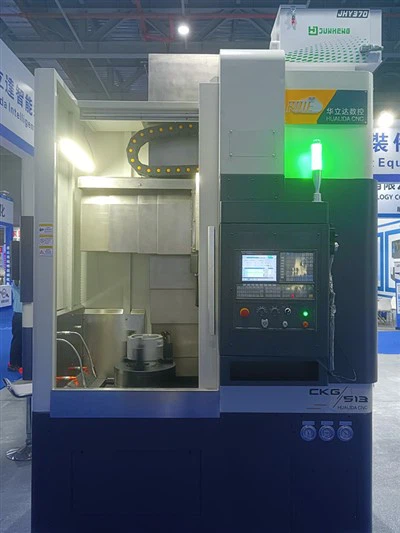
The heavy-duty vertical lathe adopts a high-rigidity frame and modular functional components design. The main structures include:
Bed and base:
Adopt high-strength cast iron or welded steel structure, and optimize the internal rib layout to ensure vibration resistance and load-bearing capacity (such as 100-ton workpieces);
The annular hydrostatic guide rail supports the rotation of the worktable, with low friction coefficient and self-balancing function5.
Spindle system:
The spindle is supported by a combination of double-row cylindrical roller bearings + tapered roller bearings + thrust cylindrical roller bearings, which has both radial centering and axial load-bearing capacity;
The main gearbox integrates a milling and turning compound drive, and directly drives the worktable through gear meshing or servo motors.
Column and beam:
The symmetrical layout of the two columns reduces the impact of thermal deformation, and the columns are embedded with preloaded hydrostatic guide rails to enhance the rigidity of the system;
The beam is driven by a dual-motor synchronously to drive the trapezoidal screw up and down, and is equipped with a safety nut and a synchronous detection device to prevent breakage.
Tool rest and slide:
The slide is supported by hydrostatic guide rails, and the built-in balancing cylinder of the ram offsets the influence of gravity to ensure vertical feed accuracy;
The tool rest supports multi-station rapid tool change, and some models integrate the ram telescopic function to adapt to complex surface processing.
CNC and auxiliary system:
The CNC system integrates multi-axis linkage control and real-time feedback (such as spindle encoder);
Equipped with hydraulic balance, oil film thickness measurement and temperature protection devices to ensure long-term stable operation.