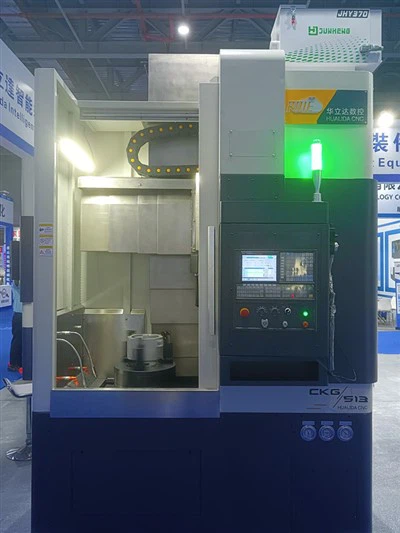
CNC lathe is one of the most widely used CNC machine tools. It is mainly used for cutting and processing of inner and outer cylindrical surfaces of shaft parts or disk parts, inner and outer conical surfaces of arbitrary cone angles, complex rotating inner and outer curved surfaces, and cylindrical and conical threads, and can perform grooving, drilling, reaming, reaming and boring.
CNC lathe, also known as CNC lathe, is the most widely used and widely covered CNC machine tool in China, accounting for about 25% of the total number of CNC machine tools. CNC machine tools are mechatronic products that integrate multiple technologies such as machinery, electrical, hydraulic, pneumatic, microelectronics and information. It is a working machine with the advantages of high precision, high efficiency, high automation and high flexibility in mechanical manufacturing equipment. The technical level of CNC machine tools and their percentage in the output and total ownership of metal cutting machine tools are one of the important indicators of a country's national economic development and the overall level of industrial manufacturing. CNC lathe is one of the main types of CNC machine tools. It occupies a very important position in CNC machine tools. It has been widely valued by countries around the world for decades and has developed rapidly.
Since the advent of CNC lathes in the 1950s, the use of CNC lathes to process parts with complex shapes in single-piece production and small-batch production has not only improved labor productivity and processing quality, but also shortened the production preparation cycle and reduced the requirements for workers' technical proficiency. Therefore, it has become an important development direction for realizing technological innovation and technological revolution in single-piece and small-batch production. Countries around the world are also vigorously developing this new technology.
We know that for parts produced in large quantities, the use of automated and semi-automated lathes can realize the automation of the production process. However, for parts produced in single pieces and small batches, automation has always been a difficult problem. For a long time in the past, it has always been unable to be satisfactorily solved. Especially in the processing of parts with complex shapes and high processing precision requirements, it has been at a standstill on the road to automation. Although some application profiling devices have solved part of the problem, practice has proved that profiling lathes still cannot completely solve this problem.