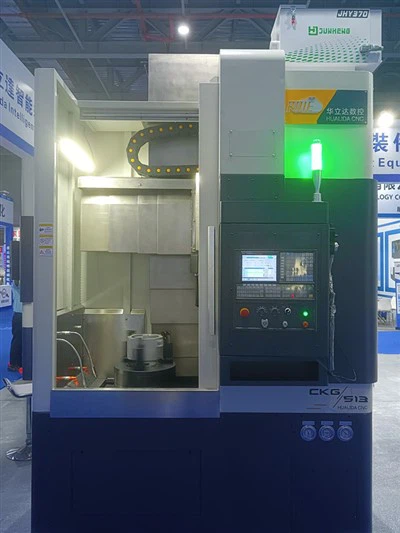
In the realm of modern manufacturing, high precision vertical lathes stand as pivotal pieces of equipment, enabling the production of complex and highly accurate components. At the heart of these machines lies a sophisticated control system, whose resolution plays a crucial role in determining the overall precision and performance of the lathe. As a leading supplier of High Precision Vertical Lathe, we understand the significance of control system resolution and its impact on machining operations. In this blog post, we will delve into the concept of control system resolution in high precision vertical lathes, exploring its definition, importance, factors affecting it, and practical implications.
Understanding Control System Resolution
The resolution of a control system in a high precision vertical lathe refers to the smallest increment of movement or change that the system can detect, measure, and control. It is essentially a measure of the system's ability to provide fine-grained control over the various axes of the lathe, such as the X, Y, and Z axes, as well as the spindle rotation. In simpler terms, resolution determines how precisely the lathe can position the cutting tool and manipulate the workpiece during the machining process.
For example, if a control system has a resolution of 0.001 mm, it means that it can control the movement of the cutting tool in increments of 0.001 mm. This high level of precision allows for the production of parts with extremely tight tolerances and intricate geometries, which are often required in industries such as aerospace, automotive, and medical device manufacturing.
Importance of Control System Resolution
The resolution of the control system is a critical factor in determining the overall performance and quality of a high precision vertical lathe. Here are some of the key reasons why high resolution is essential:
1. Precision Machining
High resolution enables the lathe to achieve extremely accurate positioning of the cutting tool, resulting in parts with tight tolerances and high surface finish quality. This is particularly important in applications where precision is paramount, such as the production of aerospace components, where even the slightest deviation from the specified dimensions can have serious consequences.
2. Complex Geometries
Modern manufacturing often requires the production of parts with complex geometries, such as curved surfaces, helical grooves, and intricate contours. A high-resolution control system allows the lathe to accurately follow these complex paths, ensuring that the final part matches the design specifications.
3. Repeatability
In mass production environments, repeatability is crucial to ensure consistent quality across multiple parts. A high-resolution control system provides reliable and consistent positioning of the cutting tool, reducing the variability between parts and minimizing the need for rework or scrap.

4. Efficiency
By enabling precise control over the machining process, a high-resolution control system can reduce cycle times and improve overall productivity. This is because the lathe can operate at higher speeds and feeds without sacrificing accuracy, resulting in faster machining times and increased throughput.
Factors Affecting Control System Resolution
Several factors can influence the resolution of a control system in a high precision vertical lathe. Understanding these factors is essential for selecting the right lathe and optimizing its performance. Here are some of the key factors:
1. Encoder Resolution
Encoders are sensors that measure the position and movement of the various axes of the lathe. The resolution of the encoder directly affects the resolution of the control system. Higher encoder resolutions can provide more accurate position feedback, allowing the control system to make finer adjustments to the movement of the cutting tool.
2. Control Algorithm
The control algorithm used in the control system plays a crucial role in determining its resolution. Advanced control algorithms can compensate for various factors, such as backlash, friction, and thermal expansion, to improve the accuracy and repeatability of the lathe. These algorithms can also optimize the movement of the cutting tool to minimize vibration and improve surface finish quality.
3. Mechanical Design
The mechanical design of the lathe, including the lead screws, ball screws, and linear guides, can also affect the resolution of the control system. High-quality mechanical components with low backlash and high stiffness can provide more precise and stable movement, allowing the control system to achieve higher resolution.
4. Environmental Conditions
Environmental conditions, such as temperature, humidity, and vibration, can also have an impact on the resolution of the control system. Extreme temperatures can cause thermal expansion and contraction of the lathe components, leading to dimensional changes and reduced accuracy. Vibration can also affect the stability of the cutting tool and the workpiece, resulting in poor surface finish quality and reduced precision.
Practical Implications of Control System Resolution
The resolution of the control system has several practical implications for the operation and performance of a high precision vertical lathe. Here are some of the key considerations:
1. Machining Tolerances
The resolution of the control system directly affects the achievable machining tolerances. Higher resolution allows for tighter tolerances, which are often required in industries such as aerospace and medical device manufacturing. When specifying the requirements for a high precision vertical lathe, it is important to consider the desired machining tolerances and select a lathe with a control system that can meet these requirements.
2. Surface Finish Quality
The resolution of the control system also has an impact on the surface finish quality of the machined parts. A higher resolution allows for smoother and more precise movement of the cutting tool, resulting in a better surface finish. This is particularly important in applications where a high-quality surface finish is required, such as the production of optical components and medical implants.
3. Programming Complexity
Higher resolution control systems may require more complex programming to achieve the desired machining results. This is because the programmer needs to specify the movement of the cutting tool in smaller increments, which can increase the complexity of the CNC program. However, modern CNC controllers often provide advanced programming features and tools to simplify the programming process and reduce the learning curve.
4. Cost
High-resolution control systems typically come at a higher cost compared to lower-resolution systems. This is because they require more advanced technology and components to achieve the higher level of precision. When selecting a high precision vertical lathe, it is important to balance the cost of the control system with the desired level of precision and performance.
Conclusion
In conclusion, the resolution of the control system is a critical factor in determining the overall precision and performance of a high precision vertical lathe. A high-resolution control system enables the lathe to achieve extremely accurate positioning of the cutting tool, resulting in parts with tight tolerances, complex geometries, and high surface finish quality. By understanding the concept of control system resolution, its importance, factors affecting it, and practical implications, manufacturers can make informed decisions when selecting a high precision vertical lathe for their specific applications.
If you are in the market for a high precision vertical lathe or need more information about control system resolution, we invite you to contact us for a consultation. Our team of experts will be happy to assist you in selecting the right lathe for your needs and provide you with the support and guidance you need to optimize its performance.
References
- "CNC Machining Handbook" by John A. Schey
- "Precision Machine Design" by Wayne C. Greenwood
- "Modern Manufacturing Technology" by Mikell P. Groover