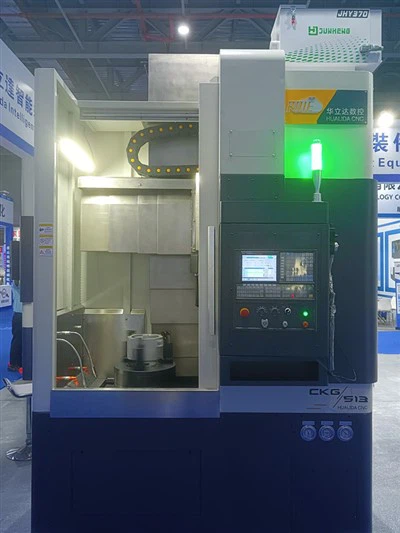
Vertical machining centers and horizontal machining centers have significant differences in many aspects, which are mainly reflected in structure, processing capacity, applicable scenarios and price.
1. Structural differences
Vertical machining center: The spindle is in a vertical state, the structure is mostly fixed columns, the worktable is rectangular, and there is no indexing and rotation function. It generally has three linear motion coordinate axes, and a rotary table rotating along the horizontal axis can be installed on the worktable to process spiral parts. The worktable is a T-slot worktable with a cross slide structure, and there are two sets of motion mechanisms responsible for movement in mutually perpendicular directions (X and Y directions).
Horizontal machining center: The spindle is in a horizontal state, and it usually has a rotary table with automatic indexing. It generally has 3 to 5 motion coordinates, and the most common ones are three linear motion coordinates plus one rotary motion coordinate. The worktable is only designed to move in the X or Y direction, and the form is generally a rotary table with a dot matrix screw hole table, which is relatively easy to select a swappable double worktable.
2. Processing Capability and Applicable Scenarios
Vertical machining center: Mainly suitable for processing complex parts such as plates, discs, molds and small shells. It can complete milling, boring, drilling, tapping and cutting threads, and is easy to install, easy to operate, easy to observe the processing situation, and easy to debug the program. However, due to the limitations of the column height and tool changer, it cannot process parts that are too high, and when processing cavities or concave surfaces, the chips are not easy to discharge, which may damage the tool and the processed surface.
Horizontal machining center: Especially suitable for processing large and heavy workpieces, as well as complex parts that require multi-station processing. Because its spindle is arranged horizontally and the workpiece is processed on a horizontal plane, it has a larger working space and can accommodate larger workpieces. Horizontal machining centers usually use a high-rigidity bed, column and spindle structure, which can withstand heavy cutting and ensure processing accuracy. It also has a multi-axis linkage function and can complete complex three-dimensional surface processing.
3. Price and complexity
Generally speaking, the price of horizontal machining centers is relatively high due to their complex structure. The vertical machining center is relatively simple in structure, occupies a small area, and is more affordable.
There are obvious differences between vertical machining centers and horizontal machining centers in terms of structure, machining capacity, applicable scenarios, and price. The choice of which type of machining center depends on factors such as specific machining requirements, workpiece type, and budget.