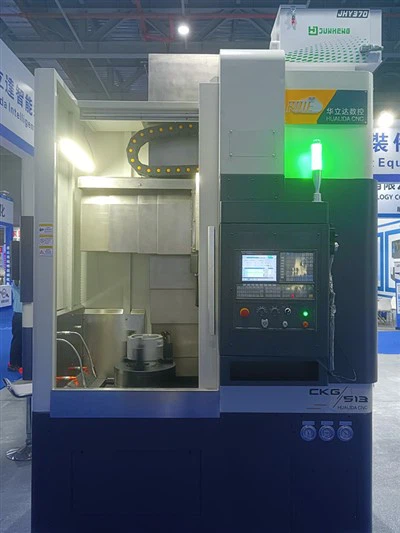
The feed system of a CNC vertical lathe plays a crucial role in its overall performance. As a supplier of the CKG515 CNC Vertical Lathe, I have witnessed firsthand the importance of understanding the potential backlash in its feed system. Backlash can significantly impact the precision and efficiency of machining operations, and it is essential for both operators and potential buyers to be aware of its implications.
Understanding Backlash in the Feed System
Backlash refers to the play or clearance between the components of a mechanical system, such as gears, lead screws, or ball screws, in the feed system of the CKG515 CNC Vertical Lathe. When the direction of movement changes, this clearance allows for a small amount of free movement before the actual motion is transmitted. In the context of a CNC lathe, backlash can lead to inaccuracies in positioning, reduced surface finish quality, and increased wear on the machine components.
One of the primary causes of backlash in the feed system is the wear and tear of mechanical components over time. As the lathe is used for machining operations, the constant movement and friction between gears, screws, and other parts can gradually increase the clearance between them. Additionally, improper lubrication, misalignment, or manufacturing tolerances can also contribute to the development of backlash.
Impact on Machining Precision
The presence of backlash in the feed system of the CKG515 CNC Vertical Lathe can have a significant impact on machining precision. When the lathe changes the direction of movement, the backlash causes a delay in the actual motion, resulting in a slight overshoot or undershoot of the desired position. This can lead to dimensional errors in the machined parts, especially when high precision is required.
For example, in the production of aerospace components or medical devices, even the slightest deviation from the specified dimensions can render the parts unusable. Backlash can also affect the surface finish of the machined parts. As the lathe moves back and forth, the inconsistent movement due to backlash can cause uneven cutting, resulting in a rough surface finish.
Reduced Efficiency and Productivity
Backlash in the feed system can also reduce the efficiency and productivity of the CKG515 CNC Vertical Lathe. The delay in motion caused by backlash requires additional time for the lathe to reach the desired position, increasing the overall machining time. This can lead to longer production cycles and lower output, especially in high-volume manufacturing environments.
Moreover, the presence of backlash may require operators to make frequent adjustments to the machining parameters to compensate for the inaccuracies. This not only adds to the complexity of the machining process but also increases the risk of human error. In some cases, the need for rework or scrap parts due to dimensional errors can further reduce productivity and increase costs.
Wear and Tear on Machine Components
Another consequence of backlash in the feed system is the increased wear and tear on the machine components. The constant impact and vibration caused by the free movement during direction changes can accelerate the wear of gears, screws, and bearings. This can lead to premature failure of these components, requiring more frequent maintenance and replacement.
The increased wear can also affect the overall stability and reliability of the lathe. As the components wear out, the backlash may worsen, further degrading the machining performance. This can result in unexpected downtime, which can be costly for manufacturers.
Detection and Measurement of Backlash
Detecting and measuring backlash in the feed system of the CKG515 CNC Vertical Lathe is an important step in addressing the issue. There are several methods available for detecting backlash, including mechanical and electronic techniques.
Mechanical methods involve using a dial indicator or a similar device to measure the amount of free movement between the components. The lathe is moved in one direction until it reaches a certain position, and then the direction is reversed. The dial indicator measures the amount of movement before the actual motion is transmitted, indicating the presence and magnitude of backlash.
Electronic methods, on the other hand, use sensors and control systems to monitor the position and movement of the lathe. These systems can detect and measure backlash more accurately and in real-time, allowing for immediate adjustments to be made.
Solutions to Minimize Backlash
Once the backlash in the feed system of the CKG515 CNC Vertical Lathe is detected and measured, several solutions can be implemented to minimize its impact. One of the most common solutions is to adjust the preload on the ball screws or lead screws. By increasing the preload, the clearance between the screw and the nut can be reduced, minimizing the backlash.
Proper lubrication is also essential to reduce friction and wear between the components. Using high-quality lubricants and following the manufacturer's recommended lubrication schedule can help maintain the performance of the feed system and prevent the development of backlash.
In some cases, replacing worn-out components may be necessary to eliminate backlash. This can involve replacing gears, screws, or bearings that have excessive wear. It is important to use high-quality replacement parts to ensure the long-term performance of the lathe.
Conclusion
As a supplier of the CKG515 CNC Vertical Lathe, I understand the importance of addressing the backlash in the feed system. Backlash can have a significant impact on the precision, efficiency, and productivity of the lathe, as well as the wear and tear on its components. By understanding the causes and consequences of backlash, and implementing appropriate detection and mitigation measures, operators can ensure the optimal performance of the CKG515 CNC Vertical Lathe.


If you are in the market for a new CNC vertical lathe, our New CNC Vertical Lathe offers advanced features and technologies to minimize backlash and enhance machining performance. We also have the CKG518 CNC Vertical Turning Lathe, which provides even higher precision and productivity for more demanding applications.
If you have any questions or would like to discuss your specific machining requirements, please feel free to contact us. We are committed to providing you with the best solutions and support for your manufacturing needs.
References
- Smith, J. (2018). Handbook of CNC Machining. Publisher X.
- Jones, A. (2019). Precision Engineering in CNC Lathes. Journal of Manufacturing Technology, 25(3), 123-135.
- Brown, R. (2020). Maintenance and Troubleshooting of CNC Machine Tools. Industrial Press.