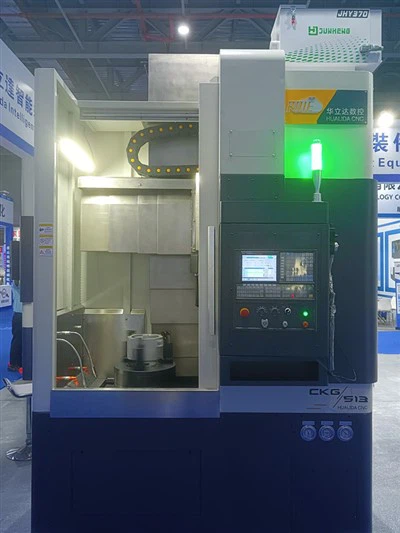
What is the rigidity of a heavy cutting vertical lathe's structure?


As a supplier of Heavy Cutting Vertical Lathes, I often encounter inquiries from customers about the rigidity of the lathe's structure. Rigidity is a crucial factor that significantly impacts the performance, accuracy, and longevity of heavy cutting vertical lathes. In this blog, I will delve into the concept of rigidity in the context of heavy cutting vertical lathes, explain its importance, and discuss the key elements that contribute to it.
Understanding Rigidity in Heavy Cutting Vertical Lathes
Rigidity, in the context of a heavy cutting vertical lathe, refers to the ability of the machine's structure to resist deformation under the influence of cutting forces, vibrations, and other external loads. A rigid structure ensures that the cutting tool maintains a stable position relative to the workpiece during the machining process, which is essential for achieving high - precision machining results.
When a heavy cutting vertical lathe is in operation, large cutting forces are generated as the cutting tool removes material from the workpiece. If the lathe's structure lacks sufficient rigidity, these forces can cause the machine components to deflect or vibrate. Deflection can lead to dimensional inaccuracies in the machined part, while vibrations can result in poor surface finish, reduced tool life, and even damage to the machine itself.
Importance of Rigidity
Precision Machining
In industries such as aerospace, automotive, and energy, where high - precision components are required, the rigidity of the heavy cutting vertical lathe is of utmost importance. For example, in the manufacturing of turbine blades for aerospace engines, even the slightest deviation from the design specifications can have a significant impact on the performance and safety of the engine. A rigid lathe structure helps to maintain the required accuracy during the machining process, ensuring that the final product meets the strict quality standards.
Tool Life
A rigid machine structure also has a positive impact on tool life. When the lathe is rigid, the cutting tool experiences less vibration and deflection. This reduces the wear and tear on the tool, allowing it to maintain its cutting edge for a longer period. As a result, the frequency of tool changes is reduced, which not only saves on tool costs but also increases the overall productivity of the machining process.
Productivity
A rigid heavy cutting vertical lathe can operate at higher cutting speeds and feed rates without sacrificing accuracy. This is because the machine can withstand the increased cutting forces generated at higher speeds and feeds. By increasing the cutting parameters, the machining time per part can be significantly reduced, leading to higher productivity.
Key Elements Contributing to Rigidity
Machine Bed
The machine bed is the foundation of the heavy cutting vertical lathe. It provides support for all the other components of the machine and must be able to withstand the cutting forces and vibrations generated during operation. A well - designed machine bed is typically made of high - strength cast iron or welded steel. Cast iron has excellent damping properties, which help to absorb vibrations, while welded steel offers high strength and stiffness. The bed should also have a large cross - sectional area and a proper ribbing structure to enhance its rigidity.
Column
The column of the heavy cutting vertical lathe supports the cross - rail and the tool head. It must be rigid enough to resist the bending and torsional forces generated during the machining process. Similar to the machine bed, the column is often made of cast iron or welded steel. The design of the column should ensure that it has a high moment of inertia, which helps to resist deformation.
Cross - rail
The cross - rail is responsible for moving the tool head along the X - axis. It must be rigid to maintain the position accuracy of the tool head. A rigid cross - rail is usually designed with a large cross - sectional area and a proper guideway system. The guideways should have high precision and low friction to ensure smooth movement of the cross - rail.
Spindle
The spindle is the heart of the heavy cutting vertical lathe. It rotates the workpiece at high speeds and transmits the cutting forces from the tool to the workpiece. A rigid spindle design is essential for maintaining the accuracy of the machining process. The spindle is typically supported by high - precision bearings, which provide both radial and axial support. The spindle housing should also be rigid to prevent deflection under the cutting forces.
Our Heavy Cutting Vertical Lathes and Rigidity
At our company, we take great pride in the rigidity of our Heavy Vertical Lathe. Our engineers use advanced design techniques and high - quality materials to ensure that our lathes have excellent rigidity.
For example, our machine beds are made of high - strength cast iron with a unique ribbing design. This not only provides high stiffness but also excellent damping properties, which helps to reduce vibrations during operation. Our columns and cross - rails are also designed with large cross - sectional areas and precision guideways to ensure accurate movement and high rigidity.
In addition, our spindles are equipped with high - precision bearings and a rigid housing design. This allows our lathes to operate at high speeds and feed rates while maintaining the required accuracy and surface finish.
Conclusion
The rigidity of a heavy cutting vertical lathe's structure is a critical factor that affects the precision, tool life, and productivity of the machining process. A rigid lathe can provide accurate and high - quality machining results, reduce tool wear, and increase overall productivity. At our company, we are committed to providing heavy cutting vertical lathes with excellent rigidity to meet the needs of our customers.
If you are in the market for a heavy cutting vertical lathe and are interested in learning more about our products, we invite you to contact us for a detailed discussion. Our team of experts will be happy to assist you in choosing the right lathe for your specific application and to answer any questions you may have.
References
- Smith, J. (2018). Machine Tool Design: An Introduction. Publisher: ABC Publishing.
- Johnson, R. (2020). Precision Machining Technology. Publisher: XYZ Press.