What is the role of the spindle orientation in a vertical CNC lathe?
Hey there! As a supplier of Vertical CNC Lathes, I've seen firsthand how crucial the spindle orientation is in these machines. Let's dive into what it means and why it matters.
First off, what exactly is spindle orientation in a vertical CNC lathe? Well, the spindle is the part of the lathe that holds and rotates the workpiece. Spindle orientation refers to the specific position or angle at which the spindle is set. In a vertical CNC lathe, the spindle is vertically oriented, which is different from a horizontal lathe where the spindle runs horizontally.
One of the key roles of spindle orientation is in precision machining. When you're working on a complex part that requires multiple operations, having the right spindle orientation can make all the difference. For example, if you need to drill holes at specific angles on a cylindrical workpiece, the ability to accurately orient the spindle allows you to do this with high precision. This is especially important in industries like aerospace and automotive, where even the slightest deviation can lead to a part being out of spec.
Another important aspect is in the setup and fixturing of the workpiece. With a vertical spindle orientation, it's often easier to load and secure the workpiece. Gravity works in our favor here. In a vertical CNC lathe, the workpiece can be placed on a chuck or fixture that is designed to hold it securely from the bottom. This reduces the risk of the workpiece shifting during machining, which can lead to poor surface finish and inaccurate dimensions.
Let's talk about chip management. In machining, chips are a by - product of the cutting process. If not managed properly, they can cause all sorts of problems, like scratching the workpiece surface or even damaging the cutting tool. The vertical spindle orientation in a CNC lathe helps with chip evacuation. Gravity pulls the chips downwards, away from the cutting area. This means that the chips are less likely to get trapped between the tool and the workpiece, resulting in a cleaner and more efficient machining process.
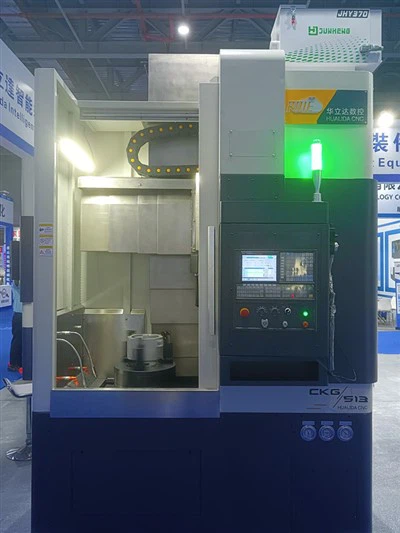
Now, let's consider the different types of vertical CNC lathes we offer at our company. We have the Vertical CNC Lathe, which is a versatile machine suitable for a wide range of applications. It can handle various workpiece sizes and materials, and the spindle orientation can be adjusted to meet different machining requirements.
For heavy - duty applications, we have the Heavy Cutting Vertical Lathe. This machine is built to withstand high cutting forces. The spindle orientation in this lathe is optimized for heavy cutting operations. It allows for a more stable cutting process, which is essential when removing large amounts of material from a workpiece.
If you're dealing with large - scale workpieces, our Large Cutting Vertical Lathe is the way to go. The spindle orientation in this machine is designed to handle the size and weight of these large workpieces. It provides the necessary support and precision for machining large - diameter and long - length parts.
The spindle orientation also plays a role in programming and automation. In a CNC lathe, the machine is programmed to perform specific operations. The spindle orientation is an important parameter in these programs. By accurately specifying the spindle orientation, the CNC system can control the movement of the cutting tool and the rotation of the spindle to achieve the desired machining results. This is especially useful in automated production lines, where multiple parts need to be machined with high consistency.
In addition, the spindle orientation affects the overall ergonomics of the machine. Operators need to be able to access the workpiece and the cutting area easily. With a vertical spindle orientation, the operator can stand in front of the machine and have a clear view of the machining process. This makes it easier to monitor the operation, make adjustments if necessary, and ensure the safety of the operator.


However, it's not all smooth sailing. There are some challenges associated with spindle orientation in a vertical CNC lathe. For example, maintaining the accuracy of the spindle orientation over time can be a challenge. Factors like thermal expansion, wear and tear, and vibration can all affect the spindle's position. That's why regular maintenance and calibration are essential to ensure the continued performance of the machine.
So, as you can see, the spindle orientation in a vertical CNC lathe is a critical factor that impacts many aspects of the machining process. Whether it's precision, setup, chip management, programming, or ergonomics, getting the spindle orientation right is key to achieving high - quality machining results.
If you're in the market for a vertical CNC lathe or have any questions about spindle orientation and its role in the machining process, we'd love to hear from you. Our team of experts is here to help you choose the right machine for your specific needs and provide you with the support you need to get the most out of it. Contact us today to start a conversation about your machining requirements.
References
- Smith, J. (2020). CNC Machining Handbook. Industrial Press.
- Jones, A. (2019). Vertical Lathe Technology and Applications. Machining World Publications.