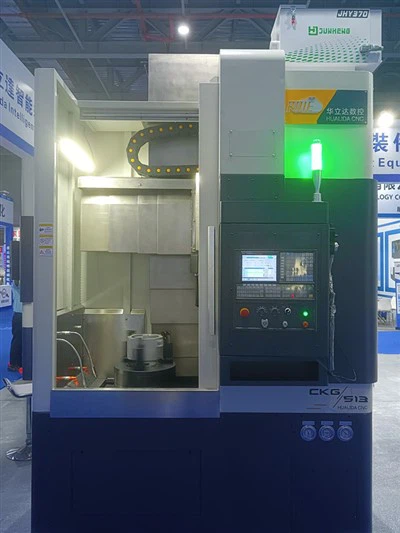
The tailstock, an often underappreciated yet vital component, plays a crucial role in the operation of a Large Cutting Vertical Lathe. As a supplier of Large Cutting Vertical Lathe, I have witnessed firsthand how the tailstock contributes to the precision, stability, and overall performance of these machines.
1. Basic Structure and Function of the Tailstock in a Large Cutting Vertical Lathe
The tailstock in a large cutting vertical lathe is typically located at the opposite end of the main spindle. It consists of a body, a quill, a handwheel or power - drive mechanism for quill movement, and various clamping devices. The primary function of the tailstock is to support the free end of the workpiece. When dealing with long or slender workpieces in a large cutting vertical lathe, the workpiece is more prone to deflection under the cutting forces. The tailstock provides an additional support point, which helps to minimize this deflection. For example, when machining a long shaft in a large - scale manufacturing process, the tailstock quill can be extended to press against the center hole at the end of the shaft. This support ensures that the shaft remains straight during the cutting operation, reducing the risk of out - of - roundness and taper errors in the finished product.
2. Ensuring Precision in Machining
Precision is of utmost importance in large cutting vertical lathes, especially when producing high - quality components. The tailstock contributes significantly to achieving this precision. By providing a stable support for the workpiece, it helps to maintain the correct alignment between the cutting tool and the workpiece. In a large cutting vertical lathe, the cutting forces can be substantial. Without proper support from the tailstock, these forces can cause the workpiece to shift or vibrate, leading to inaccurate machining results. For instance, in the aerospace industry, where components need to meet extremely tight tolerances, the tailstock ensures that large - diameter turbine shafts are machined with the required precision. The ability to adjust the position of the tailstock quill accurately allows for fine - tuning of the workpiece support, which is essential for achieving the desired surface finish and dimensional accuracy.
3. Enhancing Stability during Heavy Cutting
Large cutting vertical lathes are often used for heavy - duty cutting operations, where large amounts of material need to be removed from the workpiece. During these operations, the cutting forces can be extremely high, and the workpiece is subjected to significant stress. The tailstock acts as a stabilizing force, preventing the workpiece from moving or rotating uncontrollably. When performing heavy cutting on a large - diameter forging in a Heavy Cutting Vertical Lathe, the tailstock firmly holds the workpiece in place. This stability is crucial not only for the accuracy of the machining but also for the safety of the operator and the longevity of the cutting tools. The tailstock's clamping mechanism ensures that the quill remains in position, even under the most demanding cutting conditions.
4. Accommodating Different Workpiece Sizes and Shapes
One of the advantages of the tailstock in a large cutting vertical lathe is its flexibility in accommodating various workpiece sizes and shapes. The quill of the tailstock can be extended or retracted to adjust to different lengths of workpieces. Additionally, different types of centers can be installed in the tailstock quill to suit different workpiece requirements. For example, a live center can be used when the workpiece needs to rotate freely, while a dead center can be used for applications where the workpiece does not need to rotate relative to the tailstock. This adaptability makes the large cutting vertical lathe suitable for a wide range of manufacturing tasks, from machining small - scale precision parts to large - scale industrial components.
5. Facilitating Tooling and Setup
The tailstock also plays a role in tooling and setup processes in a large cutting vertical lathe. In some cases, the tailstock can be used to hold auxiliary tools. For example, a drill or a reamer can be mounted in the tailstock quill for performing secondary operations on the workpiece without the need to remove it from the lathe. This not only saves time but also improves the accuracy of the machining process, as the workpiece remains in the same setup. Moreover, during the setup phase, the tailstock can be used as a reference point for aligning the workpiece and the cutting tool. By adjusting the position of the tailstock and the main spindle, the operator can ensure that the workpiece is centered correctly, which is essential for achieving symmetric and accurate machining results.
6. Maintenance and Inspection of the Tailstock
Proper maintenance and inspection of the tailstock are essential to ensure its reliable performance in a large cutting vertical lathe. Regular cleaning of the tailstock body and quill is necessary to prevent the accumulation of chips, dirt, and coolant, which can affect the movement and accuracy of the quill. The lubrication of the quill and the moving parts of the tailstock should be carried out according to the manufacturer's recommendations. Additionally, periodic inspection of the tailstock's clamping mechanism and alignment is required to detect any signs of wear or damage. Any issues with the tailstock should be addressed promptly to avoid compromising the quality of the machining operations.


7. Impact on Productivity
The role of the tailstock in a large cutting vertical lathe also has a significant impact on productivity. By providing stable support and ensuring precision, the tailstock reduces the number of rejected parts due to machining errors. This means less time spent on rework and more time spent on producing high - quality components. Moreover, the ability to perform secondary operations using the tailstock and the flexibility in accommodating different workpieces contribute to a more efficient manufacturing process. In a large - scale production environment, these factors can lead to substantial cost savings and increased overall productivity.
Conclusion
In conclusion, the tailstock is an indispensable part of a large cutting vertical lathe. Its functions in supporting the workpiece, ensuring precision, enhancing stability, accommodating different workpieces, facilitating tooling, and contributing to productivity make it a key component in the manufacturing process. As a supplier of Heavy Cutting and Vertical Lathe, we understand the importance of the tailstock and are committed to providing high - quality machines with well - designed tailstocks. If you are in the market for a large cutting vertical lathe and want to discuss your specific requirements, please feel free to contact us for procurement and negotiation.
References
- "Handbook of Machine Tools", Industrial Press Inc.
- "Machining Fundamentals", Society of Manufacturing Engineers.