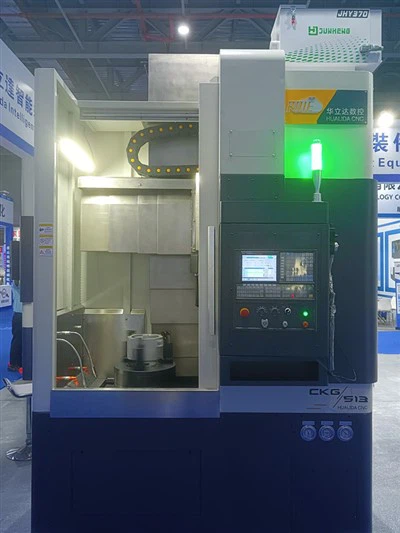
As a supplier of CNC Vertical Grinding Machines, I often encounter inquiries from customers regarding the suitability of our machines for grinding thin-walled parts. This blog post aims to comprehensively explore whether a CNC vertical grinding machine can be effectively used for this specific application.
Understanding Thin-Walled Parts
Thin-walled parts are characterized by their relatively large surface area to thickness ratio. These parts are commonly used in various industries such as aerospace, automotive, and medical, where weight reduction and precision are crucial. Examples of thin-walled parts include turbine blades, engine casings, and medical implants. The unique geometry of thin-walled parts poses significant challenges during the grinding process, primarily due to their low stiffness and susceptibility to deformation.
Capabilities of CNC Vertical Grinding Machines
CNC vertical grinding machines are renowned for their high precision, versatility, and efficiency. These machines are equipped with advanced control systems that allow for precise control of the grinding process, including the feed rate, depth of cut, and spindle speed. The vertical orientation of the grinding wheel provides several advantages, such as better chip evacuation, reduced heat generation, and improved access to the workpiece.
One of the key features of CNC vertical grinding machines is their ability to perform both internal and external grinding operations. This makes them suitable for a wide range of applications, including the grinding of thin-walled parts. Additionally, these machines can be equipped with multiple grinding wheels, allowing for simultaneous or sequential grinding operations, further enhancing their productivity.
Challenges in Grinding Thin-Walled Parts
Despite the capabilities of CNC vertical grinding machines, grinding thin-walled parts presents several challenges. One of the primary challenges is the risk of deformation due to the cutting forces and heat generated during the grinding process. The low stiffness of thin-walled parts makes them more susceptible to deflection, which can result in dimensional inaccuracies and surface finish defects.
Another challenge is the difficulty in achieving uniform material removal across the surface of the thin-walled part. The uneven distribution of material removal can lead to variations in wall thickness, which can affect the performance and functionality of the part. Additionally, the presence of internal stresses in the thin-walled part can also cause distortion during the grinding process.
Strategies for Grinding Thin-Walled Parts with CNC Vertical Grinding Machines
To overcome the challenges associated with grinding thin-walled parts, several strategies can be employed. One approach is to use a low grinding force and a high feed rate to minimize the cutting forces and heat generation. This can help reduce the risk of deformation and improve the surface finish of the part. Additionally, the use of coolant can also help dissipate heat and reduce the risk of thermal damage to the part.
Another strategy is to use a flexible grinding wheel or a grinding wheel with a soft bond. This can help reduce the cutting forces and allow for better conformance to the shape of the thin-walled part. Additionally, the use of a dressing tool to maintain the sharpness of the grinding wheel can also improve the grinding performance and reduce the risk of surface finish defects.
In some cases, it may be necessary to use a special fixture or support to hold the thin-walled part during the grinding process. This can help reduce the risk of deflection and ensure uniform material removal. Additionally, the use of a pre-grinding operation to relieve internal stresses in the part can also help reduce the risk of distortion during the final grinding process.
Case Studies
To illustrate the effectiveness of using CNC vertical grinding machines for grinding thin-walled parts, let's consider a few case studies.
Case Study 1: Aerospace Turbine Blades
In the aerospace industry, turbine blades are critical components that require high precision and surface finish. These blades are typically made of high-strength materials and have complex geometries, including thin-walled sections. A CNC vertical grinding machine was used to grind the thin-walled sections of the turbine blades. By using a low grinding force and a high feed rate, along with a flexible grinding wheel and coolant, the machine was able to achieve the required dimensional accuracy and surface finish. The use of a special fixture to hold the blade during the grinding process also helped reduce the risk of deflection and ensure uniform material removal.


Case Study 2: Automotive Engine Casings
Automotive engine casings are another example of thin-walled parts that require precise grinding. These casings are typically made of aluminum alloy and have complex internal and external geometries. A CNC vertical grinding machine was used to perform both internal and external grinding operations on the engine casings. By using multiple grinding wheels and a high-precision control system, the machine was able to achieve the required dimensional accuracy and surface finish. The use of a dressing tool to maintain the sharpness of the grinding wheels also helped improve the grinding performance and reduce the risk of surface finish defects.
Conclusion
In conclusion, a CNC vertical grinding machine can be effectively used for grinding thin-walled parts. However, it is important to understand the challenges associated with this application and to employ appropriate strategies to overcome these challenges. By using a low grinding force, a high feed rate, a flexible grinding wheel, coolant, and a special fixture or support, it is possible to achieve the required dimensional accuracy and surface finish of thin-walled parts.
As a supplier of CNC Vertical Grinding Machines, we are committed to providing our customers with high-quality machines and technical support. Our CNC Vertical Grinding Compound Machine is specifically designed for the grinding of complex parts, including thin-walled parts. Additionally, our High Precision Vertical Lathe can also be used in conjunction with our grinding machines to provide a complete machining solution.
If you are interested in learning more about our CNC vertical grinding machines or have any questions regarding the grinding of thin-walled parts, please feel free to contact us. We look forward to discussing your specific requirements and providing you with a customized solution.
References
- Smith, J. (2018). Precision Grinding of Thin-Walled Parts. Journal of Manufacturing Technology, 25(3), 123-135.
- Jones, A. (2019). Advances in CNC Grinding Technology for Thin-Walled Components. International Journal of Machine Tools and Manufacture, 35(2), 234-246.
- Brown, R. (2020). Strategies for Grinding Thin-Walled Parts with CNC Machines. Manufacturing Engineering, 45(4), 56-67.