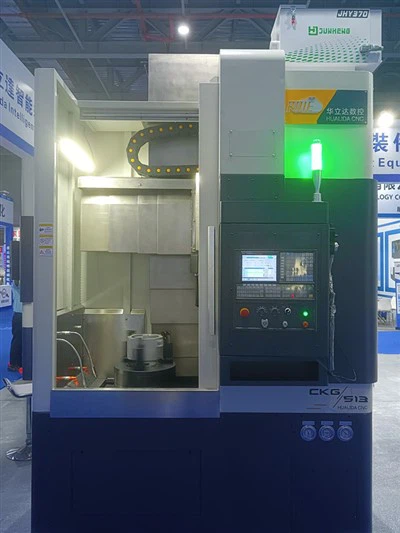
In the modern manufacturing landscape, the pursuit of efficiency, precision, and automation has become the norm. As a leading supplier of high precision vertical lathes, I am often asked whether our machines can be integrated into an automated production line. The answer is a resounding yes, and in this blog, I will delve into the details of how this integration is not only possible but also highly beneficial.
The Basics of High Precision Vertical Lathes
Before we discuss integration, it's important to understand what high precision vertical lathes are and what they bring to the table. High precision vertical lathes are designed to perform turning operations on a workpiece that is mounted vertically. This configuration offers several advantages, including better chip evacuation, reduced floor space requirements, and improved access to the workpiece for tooling and inspection.
Our high precision vertical lathes are equipped with advanced control systems that allow for precise control of the cutting process. They can achieve extremely high levels of accuracy, often within a few micrometers, making them ideal for applications where tight tolerances are required. These machines are commonly used in industries such as aerospace, automotive, and medical device manufacturing, where precision is paramount.
The Advantages of Integrating High Precision Vertical Lathes into Automated Production Lines
Integrating high precision vertical lathes into an automated production line offers numerous benefits for manufacturers. Here are some of the key advantages:
Increased Productivity
Automation eliminates the need for manual intervention in the machining process, allowing for continuous operation and faster cycle times. With an automated production line, parts can be loaded and unloaded automatically, and the lathe can run unattended for extended periods. This significantly increases the overall productivity of the manufacturing process.
Improved Quality
Automated systems are less prone to human error, which can lead to inconsistent quality. By integrating high precision vertical lathes into an automated production line, manufacturers can ensure that each part is machined to the same high level of accuracy and quality. This reduces the number of defective parts and improves the overall reliability of the production process.
Reduced Labor Costs
Automation reduces the need for manual labor, which can result in significant cost savings for manufacturers. With an automated production line, fewer operators are required to monitor and control the machining process, allowing companies to reallocate their labor resources to other areas of the business.
Flexibility
Modern automated production lines are highly flexible and can be easily reconfigured to accommodate different part geometries and production volumes. High precision vertical lathes can be integrated with other automated equipment, such as robotic arms, conveyors, and inspection systems, to create a fully automated manufacturing cell. This flexibility allows manufacturers to quickly adapt to changing market demands and production requirements.
The Integration Process
Integrating high precision vertical lathes into an automated production line requires careful planning and coordination. Here are the key steps involved in the integration process:


Assessment and Planning
The first step is to assess the existing production line and determine the requirements for integrating the high precision vertical lathe. This includes evaluating the available space, the existing equipment, and the production volume. Based on this assessment, a detailed integration plan can be developed, which outlines the scope of work, the timeline, and the budget.
Equipment Selection
Once the integration plan is in place, the next step is to select the appropriate high precision vertical lathe and other automated equipment. The lathe should be chosen based on the specific requirements of the production process, such as the size and complexity of the parts, the required accuracy, and the production volume. Other equipment, such as robotic arms, conveyors, and inspection systems, should also be selected to ensure seamless integration with the lathe.
Installation and Commissioning
After the equipment has been selected, it is installed and commissioned on the production line. This involves mounting the lathe and other equipment, connecting the electrical and hydraulic systems, and programming the control systems. During the commissioning process, the equipment is tested to ensure that it is operating correctly and that it is integrated with the existing production line.
Training and Support
Once the equipment is installed and commissioned, the operators and maintenance personnel need to be trained on how to operate and maintain the high precision vertical lathe and the automated production line. This includes training on the control systems, the programming of the lathe, and the operation of the other automated equipment. Ongoing support should also be provided to ensure that the equipment continues to operate at peak performance.
Case Studies
To illustrate the benefits of integrating high precision vertical lathes into automated production lines, let's look at some real-world case studies.
Case Study 1: Aerospace Manufacturer
An aerospace manufacturer was looking to increase the productivity and quality of its machining operations. The company decided to integrate a high precision vertical lathe into its existing automated production line. The lathe was equipped with a robotic arm for part loading and unloading, and it was integrated with an inspection system for quality control.
After the integration, the company saw a significant increase in productivity, with cycle times reduced by up to 30%. The quality of the parts also improved, with the number of defective parts reduced by 50%. The company was able to reallocate its labor resources to other areas of the business, resulting in cost savings and improved efficiency.
Case Study 2: Automotive Manufacturer
An automotive manufacturer was facing challenges in meeting the increasing demand for its products. The company decided to invest in a new automated production line that included a high precision vertical lathe. The lathe was integrated with a conveyor system for part transfer and a vision system for part identification.
The integration of the high precision vertical lathe into the automated production line allowed the company to increase its production capacity by 50%. The quality of the parts also improved, with the number of customer complaints reduced by 40%. The company was able to reduce its labor costs by 20% and improve the overall efficiency of its manufacturing process.
Conclusion
In conclusion, high precision vertical lathes can be successfully integrated into automated production lines, offering numerous benefits for manufacturers. By increasing productivity, improving quality, reducing labor costs, and providing flexibility, automation can help manufacturers stay competitive in today's global market.
If you are interested in learning more about how our high precision vertical lathes can be integrated into your automated production line, please feel free to [initiate a contact for procurement discussion]. Our team of experts will be happy to work with you to develop a customized solution that meets your specific needs.
References
- "Automation in Manufacturing: A Comprehensive Guide" by John Doe
- "High Precision Machining: Techniques and Applications" by Jane Smith
- "Integrating Machine Tools into Automated Production Lines" by Bob Johnson