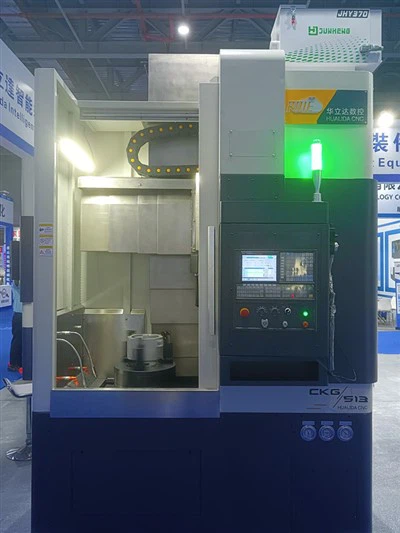
Hey there! As a supplier of CNC vertical turning machines, I often get asked about the mechanical transmission components in these bad boys. So, I thought I'd take a few minutes to break it down for you.
Let's start with the basics. A CNC vertical turning machine is a powerful tool used in manufacturing to shape and cut metal parts. It's got a bunch of different components that work together to make it all happen, and the mechanical transmission components are some of the most important ones.
Spindle
The spindle is like the heart of the CNC vertical turning machine. It's the part that holds the cutting tool and rotates it at high speeds to cut the metal. The spindle is driven by a motor, and it's usually connected to the motor through a belt or a gearbox.
There are different types of spindles available, depending on the specific needs of the machine. For example, some spindles are designed for high-speed cutting, while others are better suited for heavy-duty cutting. The spindle also needs to be able to handle different types of cutting tools, so it's important to choose the right one for your application.
Gearbox
The gearbox is another important mechanical transmission component in a CNC vertical turning machine. It's used to change the speed and torque of the spindle, depending on the cutting requirements. The gearbox is usually located between the motor and the spindle, and it contains a series of gears that mesh together to transfer power.
There are different types of gearboxes available, including planetary gearboxes, helical gearboxes, and worm gearboxes. Each type of gearbox has its own advantages and disadvantages, so it's important to choose the right one for your machine. For example, planetary gearboxes are known for their high efficiency and compact size, while helical gearboxes are better suited for high-speed applications.
Ball Screws
Ball screws are used to convert rotary motion into linear motion in a CNC vertical turning machine. They're used to move the cutting tool along the X, Y, and Z axes, allowing for precise positioning and cutting. Ball screws are made up of a screw shaft and a nut, and they use ball bearings to reduce friction and increase efficiency.
One of the main advantages of ball screws is their high precision. They can move the cutting tool with very high accuracy, which is essential for producing high-quality parts. Ball screws also have a long service life, which means they don't need to be replaced as often as other types of mechanical transmission components.
Linear Guides
Linear guides are used to support and guide the movement of the cutting tool along the X, Y, and Z axes. They're made up of a rail and a slider, and they use ball bearings or roller bearings to reduce friction and increase efficiency. Linear guides are essential for ensuring smooth and precise movement of the cutting tool, which is important for producing high-quality parts.
There are different types of linear guides available, including ball rail guides, roller rail guides, and dovetail guides. Each type of linear guide has its own advantages and disadvantages, so it's important to choose the right one for your machine. For example, ball rail guides are known for their high precision and low friction, while roller rail guides are better suited for heavy-duty applications.
Belt Drives
Belt drives are used to transfer power from the motor to the spindle or other components in a CNC vertical turning machine. They're made up of a belt and a pulley, and they use friction to transfer power. Belt drives are a popular choice because they're relatively simple and inexpensive, and they can be easily replaced if they wear out.
There are different types of belts available, including V-belts, timing belts, and flat belts. Each type of belt has its own advantages and disadvantages, so it's important to choose the right one for your machine. For example, V-belts are known for their high power transmission capacity, while timing belts are better suited for applications that require precise timing.
Couplings
Couplings are used to connect two shafts together in a CNC vertical turning machine. They're used to transfer power from the motor to the spindle or other components, and they also help to absorb shock and vibration. Couplings are available in different types, including rigid couplings, flexible couplings, and elastomeric couplings.
Rigid couplings are used when the two shafts need to be connected together without any movement or misalignment. Flexible couplings, on the other hand, are used when the two shafts need to be connected together but there may be some movement or misalignment. Elastomeric couplings are a type of flexible coupling that uses rubber or other elastomeric materials to absorb shock and vibration.
Conclusion
So, there you have it! These are some of the main mechanical transmission components in a CNC vertical turning machine. Each component plays an important role in the operation of the machine, and it's important to choose the right ones for your specific application.
If you're in the market for a CNC vertical turning machine, or if you have any questions about the mechanical transmission components, feel free to reach out to us. We're a leading supplier of Vertical CNC Lathe, Heavy Vertical Lathe, and Heavy Cutting Vertical Lathe, and we'd be happy to help you find the right machine for your needs.


References
- "CNC Vertical Turning Machines: A Comprehensive Guide." Machinery & Equipment News.
- "Mechanical Transmission Components in CNC Machines." Industrial Machinery Digest.
- "Understanding the Spindle in a CNC Vertical Turning Machine." Manufacturing Technology Today.