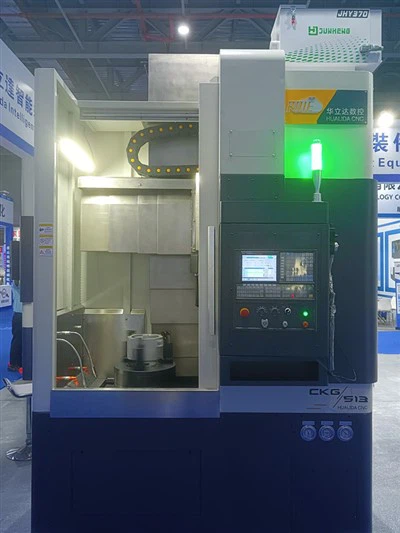
Hey there! As a supplier of CNC vertical mills, I often get asked about the difference between a CNC vertical mill and a grinding machine. It's a great question, and in this blog post, I'm gonna break it down for you.
Let's start with the basics. A CNC vertical mill is a machine tool that uses a rotating cutting tool to remove material from a workpiece. The cutting tool moves vertically along the Z-axis, while the workpiece can be moved horizontally along the X and Y-axes. This allows for a wide range of machining operations, such as milling, drilling, and tapping.
On the other hand, a grinding machine is used to remove material from a workpiece by abrasion. It uses a grinding wheel, which is a rotating wheel made of abrasive particles. The grinding wheel is pressed against the workpiece, and as it rotates, it removes small chips of material from the surface of the workpiece. Grinding machines are typically used for finishing operations, such as surface grinding, cylindrical grinding, and centerless grinding.
1. Machining Process
The most obvious difference between a CNC vertical mill and a grinding machine lies in their machining processes. In a CNC vertical mill, the cutting tool has sharp edges. When the tool rotates at high speed and comes into contact with the workpiece, it shears off the material in the form of chips. This process is great for creating complex shapes, pockets, and profiles on the workpiece. You can program the CNC system to move the cutting tool in different directions and at various depths to achieve the desired shape.
For example, if you want to make a custom - shaped part for a machine, a CNC vertical mill can easily carve out the intricate details. It can handle different types of materials like metals, plastics, and wood.
In contrast, a grinding machine uses the abrasive action of the grinding wheel. The abrasive particles on the wheel act like tiny cutting edges. As the wheel rotates and rubs against the workpiece, it gradually wears away the material. This process is more suitable for achieving high - precision finishes and tight tolerances. It's commonly used when you need a very smooth surface, like in the manufacturing of bearings or precision shafts.
2. Material Removal Rate
When it comes to the rate at which material is removed, CNC vertical mills usually have a higher material removal rate compared to grinding machines. In a CNC vertical mill, the cutting tool can take relatively large cuts at a time. The size of the cut depends on the type of tool, the material being machined, and the cutting parameters. For instance, when machining aluminum, a CNC vertical mill can quickly remove a significant amount of material, making it ideal for roughing operations where you need to get close to the final shape of the part in a short time.
However, grinding machines are designed for more precise and slower material removal. The abrasive action of the grinding wheel is more gentle, and it removes material in very small increments. This slow process is necessary to achieve the high level of precision and surface finish that grinding is known for. So, if you're in a hurry to remove a large volume of material, a CNC vertical mill is the way to go. But if precision and a fine finish are your top priorities, a grinding machine is better.
3. Precision and Surface Finish
Grinding machines are the champions when it comes to precision and surface finish. They can achieve extremely tight tolerances, often in the range of micrometers. The abrasive nature of the grinding process allows for a very smooth and even surface. You can get surface finishes with a very low Ra (arithmetical mean deviation of the roughness profile) value, which is crucial for parts that need to fit together precisely or have a low - friction surface.
CNC vertical mills can also achieve good precision, but generally not to the same level as grinding machines. The cutting process in a mill can leave some tool marks on the surface of the workpiece, especially if the cutting parameters are not set correctly. However, with proper tool selection and programming, you can still get a decent surface finish. For many applications where high - precision isn't the absolute requirement, a CNC vertical mill can provide a cost - effective solution.
4. Tooling
The tooling used in a CNC vertical mill and a grinding machine is also quite different. In a CNC vertical mill, there is a wide variety of cutting tools available. You have end mills, ball - nose mills, drills, and taps. Each tool is designed for a specific machining operation. For example, an end mill is great for flat - surface milling, while a ball - nose mill is used for machining curved surfaces. These tools can be easily changed on the CNC machine, allowing for a high degree of flexibility in the machining process.
In a grinding machine, the main tool is the grinding wheel. Grinding wheels come in different types, such as aluminum oxide wheels, silicon carbide wheels, and diamond wheels. The choice of the wheel depends on the material of the workpiece and the required finish. For example, diamond wheels are very hard and are used for grinding hard materials like carbide. Unlike the cutting tools in a CNC vertical mill, changing a grinding wheel is a bit more involved and requires proper balancing to ensure smooth operation.


5. Applications
CNC vertical mills have a wide range of applications. They are commonly used in the automotive industry for manufacturing engine parts, transmission components, and custom - made brackets. In the aerospace industry, they are used to produce complex parts for aircraft, such as wing components and turbine blades. They are also popular in the prototyping industry because they can quickly produce parts from different materials based on a CAD design.
Grinding machines, on the other hand, are mainly used in industries where high - precision and fine surface finishes are critical. The medical industry uses grinding machines to make surgical instruments and implants that require a smooth and precise surface. The electronics industry uses them for manufacturing components like semiconductor wafers, where even the slightest deviation can affect the performance of the device.
Now, let's talk about some related machine tools. If you're looking for a machine that combines the functions of turning and grinding, you might be interested in Turning and Grinding Compound Machine Tools. These machines offer the flexibility of both turning and grinding operations in one setup.
If you specifically need a vertical grinding machine, check out CNC Vertical Grinding Machine. It's designed to provide high - precision grinding in a vertical orientation, which can be very useful for certain types of workpieces.
And for those who need a more advanced solution that combines multiple grinding functions, the CNC Vertical Grinding Compound Machine is a great option.
As a supplier of CNC vertical mills, I understand that choosing the right machine for your needs can be a tough decision. Whether you're a small - scale workshop or a large - scale manufacturing plant, I'm here to help you make the best choice. If you're interested in learning more about our CNC vertical mills or have any questions about the differences between these machines, feel free to reach out. We can have a detailed discussion about your specific requirements and see how our products can fit into your production process. Let's start a conversation and find the perfect solution for your machining needs!
References
- "Machining Processes and Machine Tools" by Kalpakjian and Schmid
- "CNC Machining Handbook" by various industry experts
- Technical manuals of CNC vertical mills and grinding machines from leading manufacturers.