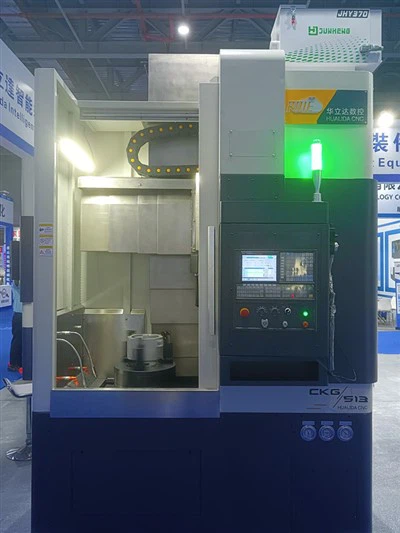
Hey there! As a supplier of CNC vertical turning machines, I often get asked about the differences between manual and CNC vertical turning machines. So, I thought I'd take a moment to break it down for you in a way that's easy to understand.
1. Basic Operation
Let's start with the basics. A manual vertical turning machine is, well, manual. You're in full control of the machine's movements. You use handwheels and levers to position the cutting tool, set the speed, and control the feed rate. It's like driving a stick - shift car. You have to be really hands - on and know exactly what you're doing.
On the other hand, a CNC (Computer Numerical Control) vertical turning machine is automated. You program the machine using a computer. You tell it where to move the cutting tool, at what speed, and how fast to feed it. It's more like driving a self - driving car. Once you've set up the program, the machine takes care of the rest.
2. Precision and Accuracy
When it comes to precision, CNC vertical turning machines are in a league of their own. Since the movements are controlled by a computer, they can achieve incredibly high levels of accuracy. The machine follows the programmed instructions to the letter, which means you can get parts with very tight tolerances. For example, if you need a part with a diameter tolerance of ±0.001 inches, a CNC machine can hit that mark consistently.
Manual machines, however, rely on the operator's skill. Even the most experienced operator might have a bit of variability in their work. Small errors in hand - cranking the levers or misjudging the feed rate can lead to parts that are slightly off - spec. So, if precision is your top priority, a CNC vertical turning machine is the way to go.
3. Production Speed
In terms of production speed, CNC machines are generally faster. Once the program is set up, the machine can run continuously without breaks. It can also perform multiple operations in a single setup, which saves a lot of time. For instance, it can turn, bore, and thread a part all in one go.
Manual machines, on the other hand, are slower because the operator has to perform each operation manually. Changing the tool, adjusting the speed, and moving the cutting tool takes time. So, if you have a large - volume production job, a CNC vertical turning machine can get the job done much quicker.


4. Flexibility
Manual machines have a certain level of flexibility. If you need to make a quick change to a part, you can just adjust the controls on the fly. You don't have to worry about reprogramming a computer. This can be really handy for small - batch production or prototyping, where you might need to make changes on the spot.
CNC machines are also flexible, but in a different way. You can easily create different programs for different parts. Once you have the program, you can reproduce the same part over and over again. And if you need to make a change to the part design, you can just modify the program instead of having to re - set up the entire machine.
5. Skill Requirements
Operating a manual vertical turning machine requires a high level of skill. The operator needs to have a good understanding of machining principles, know how to read blueprints, and be able to use hand tools effectively. It takes years of training and experience to become proficient.
Operating a CNC vertical turning machine also requires skill, but it's a different kind of skill. You need to know how to program the machine, which involves learning a programming language like G - code. You also need to understand how to set up the machine and troubleshoot any problems that might arise. However, with the right training, someone can learn to operate a CNC machine in a relatively short period of time.
6. Cost
The cost is always an important factor. Manual vertical turning machines are generally cheaper to buy. They have a simpler design and don't require the expensive computer control systems that CNC machines have. So, if you're on a tight budget and don't need high - precision or high - volume production, a manual machine might be a good option.
CNC vertical turning machines are more expensive upfront. But when you consider the long - term benefits, such as higher precision, faster production, and the ability to produce complex parts, the investment can pay off. You'll also save on labor costs in the long run because you can produce more parts with fewer operators.
7. Applications
Manual vertical turning machines are great for small - scale production, job shops, and prototyping. They're also useful for teaching purposes because they allow students to learn the basics of machining.
CNC vertical turning machines are widely used in industries where high precision and high - volume production are required. For example, in the automotive industry, they're used to make engine components like crankshafts and camshafts. In the aerospace industry, they're used to make parts for airplanes and satellites. You can find more information about different types of CNC vertical turning machines on our website: Heavy Cutting and Vertical Lathe, Large Cutting Vertical Lathe, and Vertical CNC Lathe.
So, there you have it - the main differences between manual and CNC vertical turning machines. Each type has its own advantages and disadvantages, and the right choice depends on your specific needs. If you're still not sure which one is right for you, feel free to reach out to us. We're here to help you make the best decision for your business. Whether you're looking for high - precision parts or need to increase your production volume, our CNC vertical turning machines can meet your requirements. Contact us today to start a conversation about your machining needs and see how we can work together.
References
- "Machining Fundamentals" by John Doe
- "CNC Programming Handbook" by Jane Smith