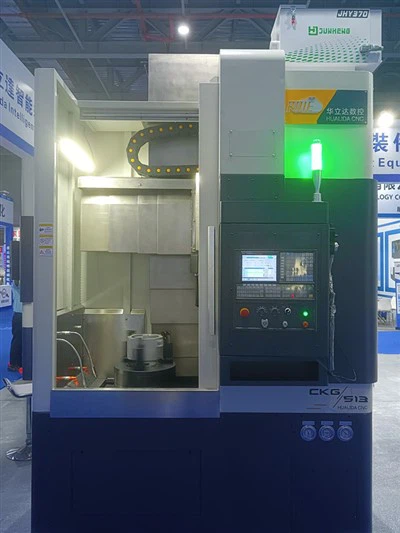
Hey there! As a supplier of Heavy Vertical Lathes, I'm super stoked to dive into the role of the encoder in these amazing machines.
Let's start with the basics. A heavy vertical lathe is a beast of a machine. It's designed to handle large and heavy workpieces, making it a go - to choice for industries like aerospace, automotive, and heavy machinery manufacturing. These lathes are capable of performing a wide range of operations, from simple turning to complex contouring.
Now, let's talk about the encoder. In a heavy vertical lathe, the encoder is like the machine's eyes and ears. It's a crucial component that provides feedback about the position, speed, and direction of the moving parts.
Position Feedback
One of the primary roles of the encoder in a heavy vertical lathe is to provide accurate position feedback. When you're working on a large workpiece, even the slightest error in positioning can lead to significant problems. The encoder helps to ensure that the cutting tool is in the exact right place at all times.
For example, if you're turning a large cylindrical part, the encoder will continuously monitor the position of the cutting tool along the X and Z axes. It sends this information back to the machine's control system, which can then make adjustments as needed. This means that you can achieve extremely precise cuts, with tolerances measured in thousandths of an inch.
Without an encoder, it would be nearly impossible to achieve this level of accuracy. You'd have to rely on manual measurements and guesswork, which is time - consuming and prone to errors. With an encoder, the process becomes much more efficient and reliable.
Speed Control
Another important role of the encoder is speed control. In a heavy vertical lathe, the speed at which the cutting tool moves and the workpiece rotates is critical. If the speed is too high, the cutting tool can overheat and wear out quickly. If the speed is too low, the machining process will be slow and inefficient.
The encoder helps to regulate the speed of the machine by providing feedback to the drive system. It measures the actual speed of the rotating parts and compares it to the desired speed set by the operator. If there's a difference, the control system can adjust the power supplied to the motors to bring the speed back to the correct level.
For instance, when you're roughing out a large workpiece, you might want to use a higher cutting speed to remove material quickly. As you get closer to the final dimensions, you'll want to slow down the speed to achieve a better surface finish. The encoder allows the machine to make these speed adjustments automatically, based on the programmed parameters.
Direction Monitoring
In addition to position and speed, the encoder also monitors the direction of movement. This is important because in a heavy vertical lathe, the cutting tool and the workpiece can move in multiple directions. The encoder ensures that the machine moves in the correct direction at all times.
Let's say you're using a Heavy Cutting Vertical Lathe to perform a facing operation. The cutting tool needs to move in a specific direction across the face of the workpiece. The encoder will detect if the tool starts to move in the wrong direction and send an error signal to the control system. This prevents the machine from making mistakes that could damage the workpiece or the cutting tool.
Types of Encoders
There are different types of encoders used in heavy vertical lathes, including incremental encoders and absolute encoders.
Incremental encoders generate a series of pulses as the shaft rotates. The number of pulses indicates the amount of movement, but they don't provide information about the absolute position. They're relatively simple and cost - effective, but they require a reference point to determine the starting position.
On the other hand, absolute encoders provide a unique digital code for each position of the shaft. This means that they can immediately tell the control system the exact position of the moving part, without the need for a reference point. They're more expensive than incremental encoders, but they offer higher accuracy and reliability, especially in applications where precise positioning is critical.
Impact on Machining Quality
The encoder has a huge impact on the quality of the machining process. By providing accurate position, speed, and direction feedback, it helps to ensure that the final product meets the required specifications.


For example, in the aerospace industry, where parts need to be manufactured to extremely tight tolerances, the encoder plays a vital role. A small error in the position or speed of the cutting tool could result in a part that doesn't fit properly or fails under stress. With an encoder, you can be confident that the parts you produce will be of the highest quality.
Integration with Other Components
The encoder doesn't work in isolation. It's integrated with other components of the heavy vertical lathe, such as the control system, the drive motors, and the cutting tool.
The control system is the brain of the machine. It receives the feedback from the encoder and uses it to make decisions about how to operate the machine. The drive motors are responsible for moving the cutting tool and the workpiece, and they rely on the encoder to regulate their speed and position. The cutting tool itself is also affected by the encoder, as its performance depends on the accurate control of the machine.
Benefits for the Operator
As an operator of a heavy vertical lathe, having an encoder in the machine offers several benefits. Firstly, it makes your job easier. You don't have to worry about manually measuring and adjusting the position and speed of the machine constantly. The encoder takes care of these tasks automatically, allowing you to focus on other aspects of the machining process.
Secondly, it improves your productivity. Since the encoder ensures accurate and efficient operation, you can complete jobs faster. You can also produce more parts in less time, which means more profit for your business.
Finally, it enhances safety. By preventing errors in positioning, speed, and direction, the encoder reduces the risk of accidents and damage to the machine. This creates a safer working environment for you and your colleagues.
Why Our Heavy Vertical Lathes are Special
At our company, we understand the importance of a high - quality encoder in a heavy vertical lathe. That's why we use only the best encoders in our machines. Our encoders are designed to be durable, accurate, and reliable, even in the most demanding industrial environments.
We also offer a wide range of Vertical CNC Lathe, Vertical Lathe Machine, and Heavy Cutting Vertical Lathe models to suit different needs and budgets. Whether you're a small - scale manufacturer or a large industrial company, we have a machine that's right for you.
If you're in the market for a heavy vertical lathe, I encourage you to get in touch with us. Our team of experts can help you choose the right machine for your specific requirements and provide you with all the support you need. We're committed to providing the best products and services to our customers, and we're confident that you'll be satisfied with your purchase.
In conclusion, the encoder plays a vital role in a heavy vertical lathe. It provides accurate position, speed, and direction feedback, which is essential for achieving high - quality machining results. Whether you're looking for a Vertical CNC Lathe or a Heavy Cutting Vertical Lathe, make sure the machine you choose has a reliable encoder. And if you're interested in our products, don't hesitate to contact us for more information.
References
- "CNC Machining Handbook"
- "Industrial Encoder Technology Guide"
- "Advanced Manufacturing Processes and Technologies"