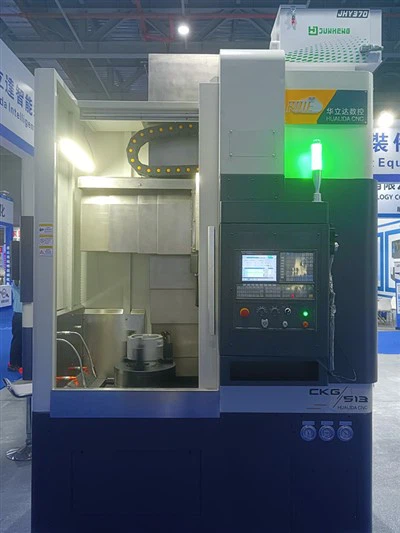
As a supplier of CNC vertical lathes, I've witnessed firsthand the diverse requirements of machining operations, especially when it comes to non - circular workpieces. Non - circular workpieces, such as cams, elliptical parts, and polygons, present unique challenges compared to traditional circular components. In this blog, I'll explore the various methods used to machine non - circular workpieces on a CNC vertical lathe.
1. Coordinate Interpolation Method
The coordinate interpolation method is one of the most common techniques for machining non - circular workpieces on a CNC vertical lathe. This method involves using the CNC system to calculate the tool path based on the geometric equations of the non - circular shape.
Linear Interpolation
Linear interpolation is a basic form of coordinate interpolation. In this method, the CNC system approximates the non - circular curve by a series of straight - line segments. For example, when machining an elliptical workpiece, the CNC controller divides the ellipse into small linear segments. The tool moves along these segments at a specified feed rate, gradually forming the elliptical shape. Our CNC Vertical Turning Lathe Machine is equipped with advanced interpolation algorithms that can accurately execute linear interpolation for non - circular machining.
Circular Interpolation
Circular interpolation is used when the non - circular shape can be approximated by circular arcs. Some non - circular profiles may have sections that closely resemble circles. The CNC system calculates the center, radius, and direction of the circular arcs and moves the tool accordingly. This method is efficient for machining parts with rounded non - circular features.
Cubic Spline Interpolation
For more complex non - circular shapes, cubic spline interpolation is often employed. A cubic spline is a smooth curve defined by a series of cubic polynomials. The CNC system uses the coordinates of a set of control points to generate the spline curve. This method can accurately represent free - form non - circular shapes, such as those found in aerospace and automotive components. Our CKG515 CNC Vertical Turning Lathe has high - precision motion control capabilities that support cubic spline interpolation for complex non - circular machining.
2. Cam - Follower Mechanism
In some cases, a cam - follower mechanism can be used in conjunction with a CNC vertical lathe to machine non - circular workpieces. A cam is a specially designed non - circular plate or disc. As the cam rotates, a follower moves in a corresponding non - circular path.
External Cam System
An external cam system can be attached to the CNC vertical lathe. The cam is designed to have the desired non - circular profile. The follower, which is connected to the cutting tool, follows the contour of the cam as the cam rotates. This causes the cutting tool to move in a non - circular path, machining the workpiece accordingly. This method is suitable for mass - producing non - circular parts with a consistent profile.
Internal Cam System
In an internal cam system, the cam is located inside the lathe mechanism. The follower and the cutting tool are arranged in a way that the tool follows the internal cam's non - circular path. This setup can provide more compact and precise machining, especially for small - sized non - circular workpieces.
3. Multi - Axis Machining
Modern CNC vertical lathes are often equipped with multiple axes, which can be used to machine non - circular workpieces more effectively.
X - Z - C Axis Machining
The X and Z axes are the standard linear axes on a CNC vertical lathe, which control the horizontal and vertical movement of the cutting tool respectively. The C axis is a rotational axis that allows the workpiece to rotate. By synchronizing the movement of the X, Z, and C axes, complex non - circular shapes can be machined. For example, when machining a helical non - circular part, the C axis rotates the workpiece while the X and Z axes move the cutting tool in a coordinated manner. Our CNC Vertical Turning Lathe offers multi - axis control capabilities, enabling precise non - circular machining with high efficiency.
Additional Auxiliary Axes
Some advanced CNC vertical lathes may have additional auxiliary axes, such as the Y axis or an additional rotational axis. These extra axes provide more degrees of freedom for machining non - circular workpieces. The Y axis can be used to perform side - facing operations on non - circular parts, while the additional rotational axis can be used for more complex angular machining.
4. Adaptive Machining
Adaptive machining is a modern approach that uses real - time feedback to adjust the machining process for non - circular workpieces.
Sensor - Based Feedback
Sensors, such as laser scanners or touch probes, can be used to measure the actual shape of the workpiece during machining. The measured data is then fed back to the CNC system. If there are any deviations from the desired non - circular shape, the CNC system can adjust the tool path in real - time. This ensures high - precision machining, especially for parts with tight tolerances.
Machine Learning - Enabled Adaptive Machining
Machine learning algorithms can be integrated into the CNC system to analyze the machining data and predict potential issues. For example, the algorithm can predict tool wear based on the cutting force and vibration data. It can then adjust the machining parameters, such as the feed rate and cutting speed, to maintain the quality of the non - circular machining.

Conclusion
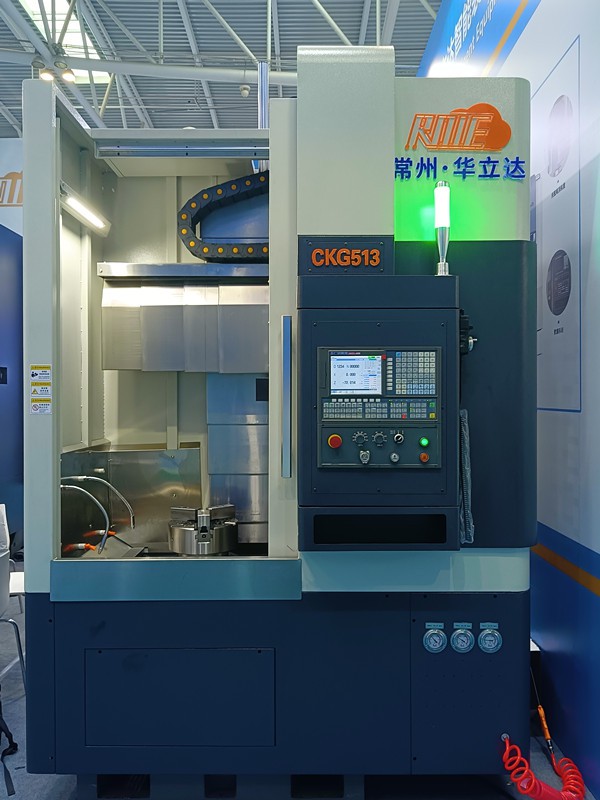
Machining non - circular workpieces on a CNC vertical lathe requires a combination of advanced techniques and technologies. Whether it's using coordinate interpolation, cam - follower mechanisms, multi - axis machining, or adaptive machining, each method has its own advantages and applications. As a supplier of CNC vertical lathes, we are committed to providing high - quality machines that can meet the diverse needs of non - circular machining.
If you are interested in our CNC vertical lathes for non - circular workpiece machining, please feel free to contact us for further information and procurement discussions. We look forward to working with you to achieve your machining goals.
References
- Smith, J. (2018). Advanced CNC Machining Techniques. Publisher: Machining Press.
- Johnson, A. (2020). Non - Circular Machining on Lathes. Journal of Manufacturing Technology, 35(2), 123 - 135.
- Brown, C. (2019). Multi - Axis Machining: Principles and Applications. Publisher: Engineering Books Inc.