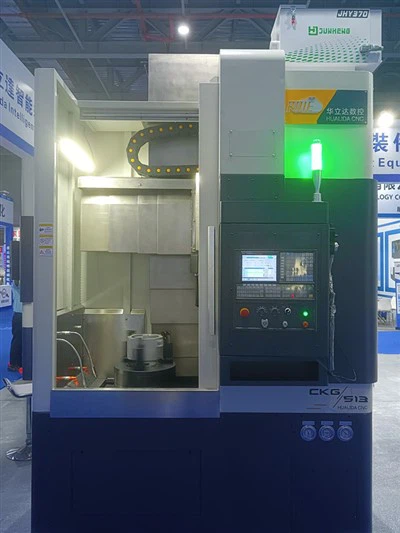
Hey there! As a supplier of CNC turning and milling machines, I'm super excited to share with you how a 5 - axis CNC turning and milling machine works. It's a pretty cool piece of technology, and once you understand the ins and outs, you'll see why it's so popular in the manufacturing world.
The Basics of CNC Machining
Before we dive into the 5 - axis stuff, let's quickly go over what CNC machining is all about. CNC stands for Computer Numerical Control. In simple terms, it means that a computer controls the movement of the machine tools. Instead of a human operator having to manually control every little movement, a pre - programmed set of instructions tells the machine what to do. This leads to much higher precision and repeatability compared to traditional manual machining.
CNC machining can be divided into two main types: turning and milling. CNC Turning and Milling is a combination of these two processes. Turning is all about rotating a workpiece while a cutting tool removes material to create a cylindrical shape. Milling, on the other hand, involves moving a cutting tool across a stationary or rotating workpiece to create various shapes, like slots, holes, and complex contours.
What Makes a 5 - Axis Machine Special?
A regular 3 - axis CNC machine can move the cutting tool along the X, Y, and Z axes. The X - axis is usually the left - right movement, the Y - axis is the forward - backward movement, and the Z - axis is the up - down movement. But a 5 - axis CNC turning and milling machine adds two more axes of movement. These additional axes are typically rotational axes. One is usually a rotation around the X - axis (often called the A - axis), and the other is a rotation around the Y - axis (the B - axis).
The ability to move in these extra axes allows the machine to access the workpiece from almost any angle. This is a game - changer in manufacturing because it means you can create much more complex parts in a single setup. With a 3 - axis machine, you might have to re - position the workpiece multiple times to get to all the surfaces you need to machine. This not only takes more time but also increases the chances of errors due to misalignment.
How the 5 - Axis CNC Turning and Milling Machine Operates
1. Design and Programming
The first step in using a 5 - axis CNC turning and milling machine is creating a design for the part you want to make. This is usually done using Computer - Aided Design (CAD) software. Once the design is complete, you need to convert it into a set of instructions that the machine can understand. This is where Computer - Aided Manufacturing (CAM) software comes in.
The CAM software takes the CAD model and generates a toolpath. The toolpath is a detailed set of instructions that tells the machine how to move the cutting tool to remove material from the workpiece. It specifies things like the speed of the cutting tool, the depth of cut, and the feed rate. The programmer also has to define the starting point, the direction of movement, and the rotation angles for the additional axes.
2. Workpiece Setup
After the programming is done, it's time to set up the workpiece on the machine. The workpiece needs to be securely clamped in place to prevent it from moving during the machining process. This is crucial for maintaining accuracy. The machine operator also has to make sure that the cutting tools are properly installed in the tool holder.
3. Machining Process
Once everything is set up, the operator can start the machining process. The machine reads the program and begins to move the cutting tool according to the specified toolpath.
In the turning operation, the workpiece is rotated at a high speed, and the cutting tool is fed into the workpiece to remove material. The 5 - axis capabilities come in handy here because the cutting tool can be angled to create different shapes on the cylindrical surface. For example, it can create grooves at an angle or complex profiles that would be difficult to achieve with a 3 - axis machine.
During the milling operation, the cutting tool moves across the workpiece while rotating. The additional rotational axes allow the tool to approach the workpiece from different angles. This is especially useful for machining complex 3D shapes, such as turbine blades or aerospace components. The machine can move the tool in a smooth, continuous motion, following the contours of the part precisely.


4. Monitoring and Adjustment
Throughout the machining process, the operator needs to monitor the machine to make sure everything is going smoothly. They can check the cutting tool for wear and tear and make adjustments to the program if necessary. If there are any issues, such as a sudden change in the cutting force or an unexpected vibration, the operator can stop the machine and troubleshoot the problem.
Advantages of Using a 5 - Axis CNC Turning and Milling Machine
- Reduced Setup Time: As mentioned earlier, the ability to access the workpiece from multiple angles means that you can complete more complex parts in a single setup. This saves a lot of time compared to using a 3 - axis machine, where you might have to re - position the workpiece several times.
- Higher Precision: With more axes of movement, the machine can achieve a higher level of precision. The cutting tool can be positioned more accurately, resulting in parts with tighter tolerances.
- Increased Complexity: You can create parts with much more complex geometries. This opens up new possibilities in industries such as aerospace, automotive, and medical, where complex parts are often required.
Applications of 5 - Axis CNC Turning and Milling Machines
These machines are used in a wide range of industries. In the aerospace industry, they are used to manufacture turbine blades, engine components, and structural parts. The high precision and ability to create complex shapes are essential for these applications.
In the automotive industry, 5 - axis CNC machines are used to make engine blocks, transmission components, and custom - designed parts. They can also be used for prototyping new parts quickly and accurately.
The medical industry also benefits from these machines. They are used to manufacture surgical instruments, dental implants, and orthopedic devices. The ability to create parts with high precision and complex shapes is crucial for ensuring the safety and effectiveness of these medical products.
Why Choose Our CNC Lathe and Milling Machine?
As a supplier of CNC Turning and Milling Machine Tools, we offer high - quality 5 - axis CNC turning and milling machines. Our machines are built with the latest technology to ensure maximum precision, reliability, and efficiency.
We have a team of experts who can provide you with technical support and training. Whether you're a small - scale manufacturer or a large - scale industrial company, we can help you find the right machine for your needs.
If you're interested in learning more about our 5 - axis CNC turning and milling machines or if you're ready to make a purchase, don't hesitate to get in touch. We're here to answer all your questions and guide you through the procurement process.
References
- "CNC Machining Handbook" by John Doe
- "Advanced Manufacturing Technology" by Jane Smith
- Industry whitepapers on 5 - axis CNC machining