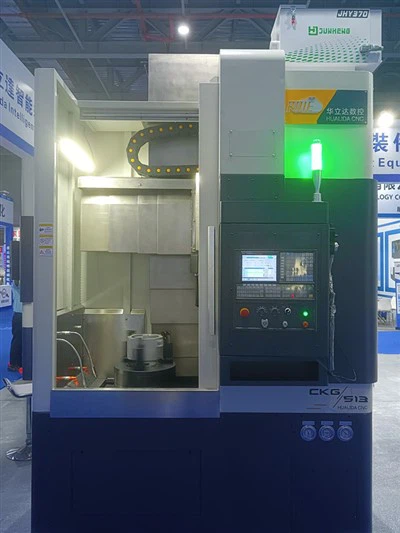
When it comes to machining on a high precision vertical lathe, the material requirements of workpieces play a crucial role in determining the quality of the final product, the efficiency of the machining process, and the overall performance of the lathe. As a supplier of High Precision Vertical Lathe, I have extensive experience and in - depth knowledge about these requirements. In this blog, I will explore the key material requirements for workpieces on a high precision vertical lathe.
1. Material Hardness
The hardness of the workpiece material is one of the most important factors. Different machining operations on a high precision vertical lathe demand specific hardness ranges. If the material is too soft, it may deform easily during the cutting process, leading to poor dimensional accuracy. For example, when turning a soft aluminum alloy, the cutting forces can cause the material to flow and create uneven surfaces. On the other hand, if the material is too hard, it can cause excessive wear on the cutting tools, increasing production costs and potentially reducing the precision of the machining.
For general machining operations on a high precision vertical lathe, materials with a hardness in the range of 150 - 350 HB (Brinell hardness) are often ideal. This range allows for relatively easy cutting while still maintaining the shape and integrity of the workpiece. For harder materials, such as some high - strength steels with a hardness above 400 HB, special cutting tools and machining parameters need to be used. These may include carbide - tipped tools with advanced coatings to withstand the high cutting forces and heat generated during the machining of hard materials.
2. Material Homogeneity
Material homogeneity is essential for achieving high - precision machining on a vertical lathe. Homogeneous materials have consistent properties throughout their volume, which means that the cutting forces and machining responses are uniform across the workpiece. When a material is inhomogeneous, it can lead to variations in cutting forces, causing the tool to vibrate and resulting in poor surface finish and dimensional inaccuracies.
For example, in castings, if there are areas with different densities or compositions due to improper casting processes, the cutting tool may experience sudden changes in resistance as it moves through the workpiece. This can lead to chatter marks on the surface of the machined part and deviations from the desired dimensions. To ensure material homogeneity, proper material selection and quality control measures should be taken. For forged materials, proper forging processes can help to improve the homogeneity by aligning the grain structure and distributing the alloying elements evenly.
3. Material Machinability
Machinability is a measure of how easily a material can be machined to achieve the desired shape and surface finish. It is influenced by several factors, including the material's hardness, microstructure, and chemical composition. Good machinability is crucial for high - precision vertical lathe operations as it allows for faster machining speeds, longer tool life, and better surface quality.
Materials with good machinability typically have a free - cutting microstructure. For example, some steels are alloyed with sulfur or lead to improve their machinability. These elements form small inclusions in the steel matrix, which act as chip breakers during the cutting process, reducing the forces on the tool and improving the surface finish. In addition, materials with a fine - grained microstructure generally have better machinability than those with a coarse - grained microstructure.


When selecting materials for high - precision vertical lathe machining, it is important to consider the machinability ratings of different materials. These ratings can be used as a guide to compare the relative ease of machining different materials and to select the most suitable one for a particular application.
4. Material Thermal Properties
Thermal properties of the workpiece material, such as thermal conductivity and coefficient of thermal expansion, also have a significant impact on high - precision vertical lathe machining. During the cutting process, a large amount of heat is generated at the cutting zone. If the material has low thermal conductivity, the heat will accumulate in the cutting area, leading to high temperatures that can cause tool wear, thermal deformation of the workpiece, and changes in the material's properties.
For example, titanium alloys have relatively low thermal conductivity. When machining titanium on a high precision vertical lathe, special cooling systems are often required to dissipate the heat effectively. On the other hand, materials with a high coefficient of thermal expansion can cause dimensional changes during the machining process due to the heat generated. This can be a problem for high - precision applications where tight tolerances are required. To compensate for thermal expansion, appropriate machining strategies, such as pre - heating or using coolant, can be employed.
5. Chemical Resistance
In some applications, the workpiece material needs to have good chemical resistance. This is especially important when the machined parts will be used in corrosive environments. For example, in the chemical processing industry or marine applications, the parts need to resist the attack of various chemicals and saltwater.
Stainless steels are a popular choice for such applications due to their excellent corrosion resistance. However, machining stainless steels on a high precision vertical lathe can be challenging because of their work - hardening characteristics. Special cutting tools and machining parameters need to be used to avoid excessive work - hardening, which can lead to poor surface finish and tool wear. Other materials, such as titanium alloys and some non - metallic materials like plastics and ceramics, also offer good chemical resistance and can be machined on a high precision vertical lathe with the appropriate techniques.
6. Material Toughness
Toughness is the ability of a material to absorb energy and deform plastically before fracturing. In high - precision vertical lathe machining, materials with sufficient toughness are required to withstand the cutting forces without cracking or breaking. This is particularly important for complex machining operations where the workpiece may be subjected to high stress concentrations.
For example, in the machining of gears or turbine blades on a high precision vertical lathe, the material needs to have good toughness to ensure that the parts can withstand the dynamic loads during their operation. Materials like alloy steels with a proper balance of strength and toughness are often used for such applications. These steels can be heat - treated to achieve the desired combination of properties.
Conclusion
In conclusion, the material requirements for workpieces on a high precision vertical lathe are diverse and interrelated. Material hardness, homogeneity, machinability, thermal properties, chemical resistance, and toughness all need to be carefully considered when selecting materials for high - precision machining. As a supplier of High Precision Vertical Lathe, we understand the importance of these factors and can provide technical support and advice to our customers on material selection and machining processes.
If you are in the market for high - precision machining solutions or have specific requirements for workpiece materials, we are here to help. Our High Precision Vertical Lathe is designed to meet the most demanding machining needs. We also offer a range of related products such as Fixed Beam CNC Vertical Milling Machine and Turning and Grinding Compound Machine Tools to provide comprehensive machining solutions. Contact us to discuss your requirements and start a procurement negotiation today.
References
- Kalpakjian, S., & Schmid, S. R. (2008). Manufacturing Engineering and Technology. Pearson Prentice Hall.
- Trent, E. M., & Wright, P. K. (2000). Metal Cutting. Butterworth - Heinemann.
- Schey, J. A. (1987). Introduction to Manufacturing Processes. McGraw - Hill.